
Steven Shapin at the LRB:
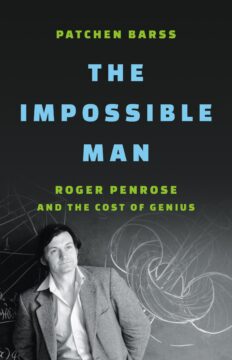
Roger Penrose liked puzzles. In the 1950s, inspired by a catalogue of prints made by the paradoxical Dutch artist M.C. Escher, the young Penrose and his psychiatrist-geneticist father, Lionel, set out to produce drawings of ‘impossible objects’. Pictorial conventions cue us to perceive two-dimensional drawings as representations of three-dimensional things, but these conventions can also be used to deceive – for example, to depict things that could not exist in three dimensions. One of these objects became known as the ‘Penrose triangle’.
The Penroses were a family of puzzlers. Father and sons amused themselves by constructing polyhedra out of wood and cardboard that could be taken apart and put together in interesting ways. Everyone played chess: Lionel set puzzles and his wife, Margaret, like him a qualified physician, was a keen player; Oliver Penrose, Roger’s older brother, is a physicist and a proficient amateur player; and his younger brother, Jonathan, was a grandmaster and ten times British chess champion. But there was much more to Roger’s puzzling than this.
more here.
Enjoying the content on 3QD? Help keep us going by donating now.