
by O. Del Fabbro
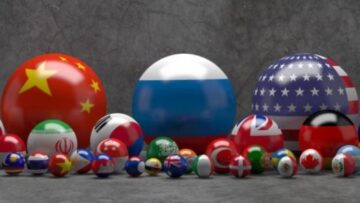 In 2007, at the Munich Security Conference, Vladimir Putin announced that the current world order had changed. The unipolar world order, with one centre of power, force and decision-making, was unacceptable to the leader in the Kremlin. Yet, more than that, Putin’s speech prepared the replacement of the unipolar world order, a replacement, he would later come back to, over and over again: multipolarity.
Putin himself thus sees a continuation between the unipolar world order and the multipolar world order. But Putin also regularly looks back at the world order that was in place before the unipolar world order reigned: bipolarity. Putin is, as we know, the greatest critic of the Soviet Union and of its weakness and collapse. It brought nothing but economic chaos and political anarchy. Putin blames the Soviets to have created Ukraine, they gave the “little brother” its national identity, that today Ukrainians are claiming for themselves. In Putin’s narrative, the unipolar world order has only existed since the collapse of the Soviet Union, and was itself preceded by bipolarity. To sum up: the narratives of unipolar, bipolar and multipolar world orders are connected, and cannot be looked at separately. They are evolutionary linked to one another and represent a historical development.
My claim is that to speak of unipolar, bipolar and multipolar world orders means to think in imperial terms, which neglects the complexities of local and internal struggles, of ideological, religious, political, social, economic and many more dimensions.
In imperialistic world order views, wars and conflicts are nothing else than side effects of specific world orders. After WWII for example, a bipolar conflict emerged between the US and its allies on the one hand and the USSR and its allies on the other. It was mainly a conflict of political and economic differences: democracy versus communism, capitalism versus planned economy. Especially on economic and scientific grounds, an arms race in nuclear weapons led to the national security strategy of MAD, mutually assured destruction. The cold war. In that narrative, all hot wars were nothing but proxy wars of the bipolar world order: the Korean War, Vietnam, Angola, Chile, Nicaragua, Congo, Cuba, Afghanistan. Because the cold war was a conflict between two superpowers, that was mainly based on an economic level, the winner of that war, the US, wrestled down its opponent, the USSR, economically. The result was Putin’s unipolar world order, in which the US was the sole economic superpower, a highly militarized Globo-Cop, and role-model and defender of the democratic way of life.
Yet, under the unipolar world order of the US, a multipolarity was crystallizing, because single nation states such as Brazil, Russia, India, China, South Africa, Iran and others profited from the capitalistic world market in which they were participating and thus developed drastically on all levels: economically, militarily, geopolitically. In that multipolar world order, every nation state has its own spheres of influence: Putin’s wars in Chechnya, Georgia, Ukraine, Syria; China’s cultural fight against Tibet, the Uigurs and the siege of Taiwan; the involvement of Iran in the current war in Gaza, in Lebanon, in Yemen; the conflict between India and Pakistan and so on. The narrative of the multipolar world order is nothing else than a justification for autocrats such as Putin, Xi Jinping, Narendra Modi, and lately also Donald Trump, to legitimize conflicts in what they consider their personal and/or national spheres of influence.
For example: In Putin’s narrative, the colour revolutions in Ukraine, Georgia, Belarus, Kyrgyzstan and so on, and the Arab spring uprisings in Libya, Egypt, Syria, Tunisia and so on, are the result of American interference based on, to repeat, an unipolar world order, in which the US wanted to spread democratic pro-American thinking and political systems around the globe. The same rationale can be said for Kissinger’s claim of a bipolar world order, in which two major powers, the US and USSR, were fighting over world dominance, while all other wars became, as I have already said, proxy wars.
If we have a closer look at the wars in Korea, Vietnam, Angola, Chile, Nicaragua, Congo, Cuba, Afghanistan though, we do see involvement of the US and USSR, yes, however, these conflicts represent much more than just a theatre of American and Russian interests. These wars were also about ideology, internal social and political struggles, resembling more civil wars. From the perspective of these countries, the conflicts were aims of liberation. The US and USSR simply got involved in already existing internal conflicts. Similarly, we have to interpret the colour revolutions and the Arab spring. The fact that popular and democratic movements emerge bottom-up is incomprehensible for Putin. Yet, this is exactly what happened and it was only later, when the conflicts had already emerged, that other actors such as NATO, Russia, Iran, got involved more concretely.
The problem of the narrative of unipolarity, bipolarity or multipolarity is a question of focus. What is more accurate is a more complex perspective, which considers locality and idiosyncratic features. The world does not have a predefined order, it is rather a map, on which the potential for armed conflict is locally determined and intensified because of many reasons: ideological, cultural, material resources, religious etc. If there is such a thing as a world order, then it is complex, meaning that abstraction to a global perspective needs to be abandoned in order to zoom into local networks. Complexity is hidden, there are a multitude of complicated, intertwined reasons for conflicts. In that sense, the world cannot be ordered globally. It is always fragmented. The narratives of unipolar, bipolar and multipolar world orders are therefore nothing but reductionisms. Their aim is not descriptive adequacy, but rather justification for the involvement in self-designated spheres of influence, usually for imperial aims.
If realism is the rational assessment of the current game of powers (without ideology and ethics) and how to best conduct diplomatic and political policies in order to navigate successfully through that game of powers, then it should consider the complex perspective: think locally, before globally. The cold rational interest of major powers, playing poker against one another on a world map, on which smaller powers are nothing but poker chips, is the realist’s fallacy that supports the narrative of unipolar, bipolar or multipolar world order views. In that sense, realism supports imperial rationalizations. From the complex perspective, this world view has to be given up.
The complex perspective does differentiate between major or minor powers in terms of importance, it looks at the local emergence of power structures and conflicts, and considers international, global relations. But it refuses a homogeneous description of world orders, be they unipolar, bipolar or multipolar.
***
Enjoying the content on 3QD? Help keep us going by donating now.