
by Daniel Shotkin
As any teacher would agree, it’s incredibly difficult to get a classroom of teens to focu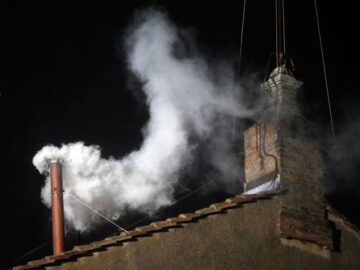 s on a common topic. Yet at noon on May 8th, all 16 high school seniors in my AP Lit class were transfixed by one event: on the other side of the Atlantic, white smoke had come out of a chimney in the Sistine Chapel. “There’s a new pope” was the talk of the day, and phone screens that usually displayed Instagram feeds now showed live video of the Piazza San Pietro in Rome.
What is it about a bureaucratic election in a 2,000-year-old microstate that so completely captivated my class?
On paper, the Catholic Church has no business occupying the attention of anyone in secular society, let alone a group of teens who’ve never stepped foot in a church in their lives. Long gone are the days when the Papacy positioned itself as the world’s divine arbiter of authority. Kingly excommunications are few and far between, and the Pope—once ruler of a vast swath of central Italy—is now confined to a hill in Rome.
Despite all these changes, the Pope still occupies an outsized role in the popular imagination. Why? Because the papacy is a living inheritor of two historical narratives that continue to captivate Western thought.
∗ ∗ ∗
When Cardinal Robert Prevost stepped onto the central loggia of St. Peter’s Basilica for the first time as Pope Leo XIV, he looked out at a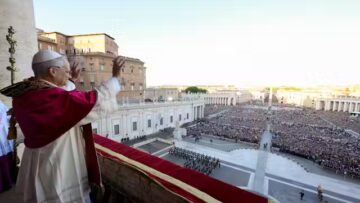 crowd of 150,000 gathered below him. But if he could look beyond the Piazza San Pietro, over the banks of the Tiber River, and past the pompous Victor Emmanuel II Monument, he would see the ruins of what was once the heart of Imperial Rome.
Incredibly, with his election to the papacy, Robert Prevost can now trace his line of predecessors to a time when those ruins were the bustling center of a flourishing Mediterranean empire. Two hundred sixty-seven papal predecessors separate Bob Prevost from Shimon Bar Yonah, a Jewish fisherman born in 1 BC. Shimon. That fisherman—renamed Peter by a certain Nazarene carpenter—would go on to found the Christian Church in Rome.
No other modern institution—aside from maybe the descendant of Confucius in China, passed down since 479 BC—rivals the papacy’s historical longevity. This continuity opens the first historical narrative inherited by the papacy: the story of Jesus and his apostles.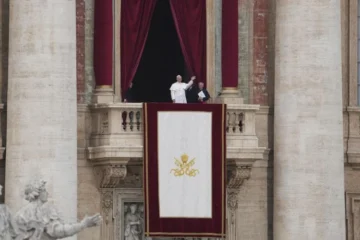
One of Catholicism’s key differences from Protestantism is the concept of apostolic succession—the belief that the authority of the Church is passed down through an unbroken line of bishops dating back to the apostles. Though this idea isn’t exclusive to Catholics (it’s also present in Orthodox and Anglican churches), Catholicism’s singular focus on the Pope’s connection to St. Peter—the first Bishop of Rome—sets it apart.
Before any cardinal or pope stepped onto the balcony of St. Peter’s Basilica, the first thing onlookers saw was a giant banner emblazoned with a pair of crossed keys. The banner depicted the keys to heaven, the same keys Jesus gave to Peter and, by Catholic extension, the Pope. In this way, the Pope’s theological authority is based on a foundational narrative: that the man on the balcony is, through an unbroken spiritual lineage, a disciple of Jesus.
So we’ve established that the Pope represents a tangible connection to the twelve apostles. But how much of that connection is actually historical?
∗ ∗ ∗
According to Catholic belief, St. Peter was crucified upside down on the orders of Emperor Nero. And though we don’t have scholarly evidence that Peter ever set foot in Rome, we do know that early Christians had a rocky relationship with the pagan empire.
The first persecution of Christians began after Nero blamed the sect for igniting the Great Fire of Rome in 64 AD. According to Tacitus, Christians were torn apart by dogs, crucified, and burned alive to serve as “nighttime lamps” in Nero’s gardens. Of the first 31 bishops of Rome, it’s believed that 27 or 28 died as martyrs.
But as the tiny messianic offshoot of Judaism began accepting Gentiles in the early 2nd century, it rapidly grew into a web of Mediterranean churches that, by the 4th century, comprised a noticeable chunk of the empire’s population. In 312, Constantine, motivated by either a divine vision or the potential to unify a fracturing empire, converted to Christianity. But crucially, Christians still made up only about 3 million of the empire’s 60 million inhabitants.
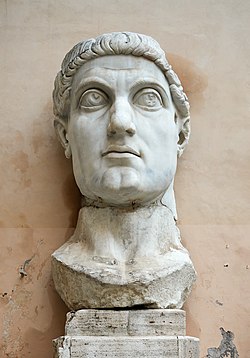 Was Constantine the driving force behind Christianity’s rapid growth, or merely a symptom of it? We don’t know. But Christianity’s troubled relationship with the Roman state turned into toleration, then symbiosis. The empire quickly became synonymous with Christianity—until the 5th century, when the state withered away, and the Roman bishop was all that remained. So the Bishop of Rome became more than just a descendant of Peter—he became the last surviving representative of the Roman Empire.
Were it not for Rome and its eventual fall, we wouldn’t have a Pope. It was Rome that turned Latin—the language of Jesus’ executioners—into the language of the Church. No Latin—no habemus papam, no in nomine Patris. The birth of Christ, whose date goes unmentioned in the Gospels, is celebrated on December 25th because that’s when pagan Romans celebrated the winter solstice. The Pope—known in antiquity simply as the Bishop of Rome—is officially titled the Pontifex Maximus (Chief Priest) because that was the title every Roman emperor from Augustus onward gave themselves.
Notably, these distinctions are absent in Orthodox Christianity, where the Roman Empire persisted for another thousand years. In Eastern Roman churches, Greek—the language of the Gospels—remained the language of the Church, and the Pope wasn’t seen as the supreme representative of the Church, but rather as primus inter pares—first among equals. The Pope’s title of Pontifex Maximus only came into official use after the fall of the Byzantine Empire in the 15th century, as a move to link the papacy to the legacy of Rome.
So the papacy isn’t just a descendant of the original Jesus sect of first-century Judaism—it’s also the only remaining representative of the legacy of Rome. A fate poor Nero would not be happy with.
∗ ∗ ∗
So the Pope is related to Jesus and Rome. What else is new? Well, the strength of these associations gives the Pope a spiritual credibility that is unique in the Western world. The papacy’s extraordinary age allows it to exist outside the scope of ordinary authority.
Politically, the Vatican is the only absolute monarchy in Europe, and one of seven globally. Its king resides in a grandiose palace filled with priceless Renaissance art, and its bureaucracy controls a bank and a modest Swiss army. But this monarch is elected, and his power doesn’t lie exclusively in material might. Rather, the Holy See’s influence stems from its spiritual leadership over a billion believers—a leadership made possible by these two enduring narratives.
The Pope’s unique moral authority also grants him a special role as we enter a new technological revolution. Pope-elect Robert Prevost understands this better than anyone. His chosen papal name isn’t a coincidence. The last Pope Leo—Leo XIII—is widely known for leading the Church through the Industrial Revolution. His encyclical Rerum Novarum, or Rights and Duties of Capital and Labor, instructed bishops on how to address rampant poverty and inequality brought on by European industrialization.
Leo wrote that a “remedy must be found quickly for the misery and wretchedness pressing so unjustly on the majority of the working class.” He treaded a fine line between the rising Socialist movement and the newly formed industrial capitalist class—a nuance only possible for an institution with the existing authority of the papacy.
Prevost’s chosen name positions him as a similar source of authority, this time for the potential social upheaval that might result from an AI revolution. The replacement of human labor is eerily similar to industrialization’s disruption of traditional social structures and labor hierarchies. As the world enters a new era of technological and political change, the Pope’s authority might take on a new light.
The papacy’s 2,000 years of history could, ironically, make it one of the most future-proof institutions on earth. For Leo XIV, the power that once came from Peter and Rome now stems from something else entirely: being extraordinarily unchanging in a world full of change.
Enjoying the content on 3QD? Help keep us going by donating now.