
by Angela Starita
Driving through Journal Square in Jersey City with a friend, we’re both amazed by the construction that has happened there in the last two years. In this case, amazement is a form of horror: the new buildings, an array of towers, are grotesquely out of scale with the rest of the city. The worst offender is a blue-glass behemoth calling itself The Journal, the name serving as the only reference to its setting in Journal Square. As you head north, Kennedy Boulevard, the city’s main thoroughfare, veers to the left and heads up to Union City, West New York, and North Bergen. Until a few years ago, that curve underscored the Boulevard’s role as a connector, a common thread and organizing principle of those Hudson County towns, starting to the south in Bayonne. Now the approach to the Square is dwarfed by the new building, one of dozens that have gone up in a 10-block radius in fewer than 5 years. The road itself goes unimpeded, but visually the building creates a massive visual wall, intimidating, arrogant, an absolute full stop.
My friend says what he dislikes most about so much new construction is its uniformity, so unrelated to the specifics of a place. I do a bad job trying to explain the roots of un-placeness in Modernist architecture: how after the bloodshed of World War I, European architects thought they had a duty to create work that could be, as they saw it, universal. I talk about Le Corbusier’s design of the Villa Savoye as its own system, regardless of landscape, that could be plugged into almost any setting. It was like making an Esperanto for space, I say; the idea was to supersede national styles and create buildings that met people’s needs without recourse to ornament or any device that covered structural “truth.” To these architects, if our organization of space could literally foster communication, maybe prevent even war. I want my friend to see that whatever the motivations of developers, the history of architecture as disconnected object has at least some noble roots. Well, he said, I still don’t like that it has nothing to do with where it’s being built.
Solutions to the problem at the heart of our exchange—how to shape, update, and expand a physical environment with integrity—have been varied and frequently polemical: the tabula rasa approach of Le Corbusier, in some ways epitomized by Brasilia, is a frequent if misunderstood whipping boy of both urbanists and the public. And while there’s a complex and sometimes poignant story behind those plans, I can’t disagree that the results of such ready-made towns—those designed by famous architects as much as the off-the-shelf developments across the country—are alienating. And of course, the blank-slate philosophy is appealing in a country where economic health is measured in housing starts. In Florida, my father’s town bought his tiny neighborhood, mostly woods, via eminent domain. Their nominal object was to create a more walkable environment by tearing down the existing houses and building new houses along with a nearby shopping street. When I asked a town manager, why not just incorporate the existing dozen or so houses into the plan, he claimed that developers only want a blank slate. Who knows if this was accurate or not, but he certainly told the truth when I asked why do this at all? “That area doesn’t generate enough income.”
But those contesting the blank slaters tend to be doctrinaire and simplistic. Take the writer James Kunstler who lays all the negatives of much development—social isolation and extraordinary rates of pollution (demolition and construction accounts for more than a third of the world’s waste)—at the feet of Henry Ford and the development of car culture. When I read his book The Geography of Nowhere, I could smell the gooey sucrose of nostalgia, but also shared his anger at all the boring sameness of those developments I used to see from the window of my mother’s car whenever we drove to the nearest mall. Like a lot of people, I hated living in suburbia, or in my case, a rural corner of it, so far from anything that even vaguely interested me. How I pitied myself for living in a place where the 7-11 parking lot functioned as town square and community center! I wanted to live in a neighborhood not on a farm far from other houses in a town with Route 9, one called the old Atlantic City Road, as its center.
But as David Harvey explained in a 1997 essay, “The New Urbanism and the Communitarian Trap,” Kunstler and a group of planners referred to as the New Urbanists worked under an untested assumption: “that neighborhoods are in some sense ‘intrinsic,’ that the proper form of cities is some ‘structure of neighborhoods,’ that ‘neighborhood’ is equivalent to “community,” and that ‘community’ is what most Americans want and need (whether they know it or not).”
Starting in the 1970s, the New Urbanists systematically analyzed suburban sprawl and it’s no-whereness to assess its shortcomings. They then studiously determined practical, economical methods for combatting uniformity to preserve or possibly generate local community. They believed that shops and municipal services should be centered around neighborhoods and within walking distance of all residences; everyone should have easy access to public transportation; buildings should be relatively low in scale; and there should be plenty of public space.
More than the assumptions about the benevolent power of neighborhoods, the New Urbanists, Harvey argues, operate from an even more damning assumption, the same one their tabula rasa forebears also took for granted: namely, that critical societal problems can and should be resolved via the arrangement of space, what Harvey calls “spatial determinism.” I’m drawn to the New Urbanist ideas, find comfort in them, but Harvey’s point is irrefutable: those ideas presume a faith in the power of form to mitigate a host of factors not least of which are the political and economic forces outside of any one community’s ecosystem.
Harvey’s essay reminds me of a trip I once made to Newbern, Alabama to visit Rural Studio, an architecture program associated with Auburn University. Begun as an experiment by Samuel Mockbee, the studio required students to build a house out of found and low-cost materials for one resident of Hale County every semester. The region, made famous by James Agee and Walker Evans’ portraits of Depression-era poverty in Let Us Now Praise Famous Men, is a place where the importance of architecture, or its absence, can be measured in stark terms. Most people live in decrepit trailers or shacks, and, as I recall, public transportation is limited to infrequent bus service.
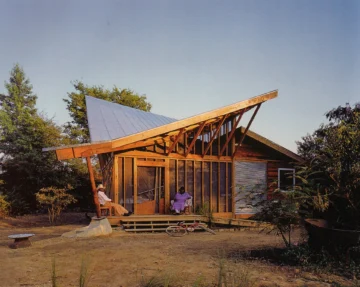
Seeing the architecture students created there moved me deeply, made me want to talk and be silent all at once. These are small houses and other structures ( a chapel, a bus stop), but they’re made with such satisfying ingenuity: a glass canopy made of discarded windshields, walls constructed of hay bales reinforced with concrete, a roof of used metal road signs, rammed earth parapets. They are also beautiful in their forms and proportions, a fact that may be underscored by the unlikeliness of finding these houses in a setting of rusted trailers. And yet, they’re not in any way disruptions of the landscape but weirdly fitting, almost inevitable, that is, if every designer could take time enough and care to study a setting and a client’s needs as carefully as Mockbee’s students had.
I was on the trip to meet residents of the houses, and all were proud to show them to me. The last woman I met with was a young nursing student living with an elderly relative, for whom Rural Studio had built the Patrick House. Like her neighbors, she enjoyed their house, was very pleased with its light-filled layout, its good insulation, its bright colors, and how it had greatly improved their living conditions out there on a small road on the edge of the woods far from any stores, hospitals, or libraries (though one was finally built in 2018). Then I asked her what she would do once she graduated. She answered immediately: “Get out of here.”