
by Eric Feigenbaum
The smell of Thai Boat Noodles always reaches to the parking lot. As you walk further into the Weekend Food Market at the Wat Thai of Los Angeles, whiffs of fish sauce, shrimp paste, garlic, frying rice noodles and more start to chime in. But always the Boat Noodles.
“This smells like Thailand!” my eleven-year-old son said the first time I took him last year.
Of any country I’ve ever visited, Thailand by far has the best developed and varied street food scene. Like my son said, the smells are both strong and recognizable. In Bangkok there are streets, back alleys, parks, bus stations and train depots that could vie for best “restaurant” in the world if they were somehow formally organized. During the time I lived in Thailand, I used to consider the Southern Bus Terminal my favorite buffet because of the combination of food carts and vendors.
In Thailand, delicious food is cheap and ubiquitous. It also makes for messy streets and back alleys – which are the heart of Bangkok neighborhoods. Sidewalks can be overtaken by food sellers with their makeshift tables and stools. Food vendors often occupy narrow lanes in alleys and interfere with the flow of traffic even on main roads. Thai culture has a high tolerance for disorganization many Americans might consider near-chaos.
Every Southeast Asian country has street food and the disorganization it brings to streets and sidewalks. The food is a treasured part of their cultures and also a major convenience. Good, healthy, tasty food at a reasonable price can be steps from your home or business.
In 1965 when Singapore achieved independence, it was no different from its neighbors. In fact, it may have rivaled Thailand for an incredible and chaotic street food scene. Singaporean street food not only features the many specialties of its major constituent cultures – Chinese of numerous regions, Malay and Tamil Indian – but as one might expect of a multi-cultural island, people began experimenting with fusion. A little Malay spice in a traditionally bland Chinese noodle dish…. An Indian-inspired curry sauce to accompany a Malay staple…. Fish head curry becoming a national dish. Same with pepper crab and laksa.
Singaporeans loved their street food. Only their government hated that it was on the street.
This was for several reasons. First and foremost, Singapore’s leaders wanted to attract foreign direct investment and therefore wanted an orderly, presentable city-state. Streets littered with food carts, barbecues and masses of people wasn’t the right image. Secondarily, the government had many initiatives to improve public health through better sanitation – which as they often argued, mattered extra in a hot, tropical environment. Just the lack of running water alone….
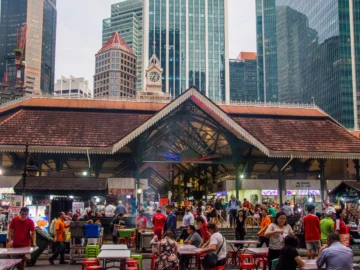
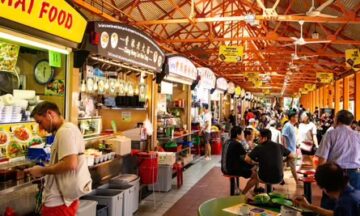
So Singapore’s founding fathers devised a plan to keep their cultural legacy and source of good affordable food while cleaning up the streets and everyone’s hands: Hawker Centers. The government constructed two and three-story cement-block buildings full of food stalls. Each stall has a small kitchen equipped with running water, propane hookups and electricity. They are essentially very large, modular food courts with lots of seating between clusters of food stalls. And of course, public restrooms with soap and paper towels.
Naturally, Hawker Centers improved with time. Newer and remodeled ones are more polished and have some charm like Lau Pa Sat (refurbished during COVID) near the Financial District and Newton Circus – one of Singapore’s busiest and most renown Hawker Centers that was practically rebuilt in the mid-aughts.
As a result, Singapore went from being an island of street-food vendors to a nation of food courts. In fact, government-sponsored Hawker Centers became so popular the private sector saw an opportunity to draw in customers wanting a quieter, cleaner and air-conditioned environment. Today, not only does every mall have a food court, but food courts without malls abound. Sure, food prices are higher than at the outdoor Hawker Centers, but the air-conditioning can be worth it on a muggy Singapore day.
Of course, one thing the private food courts lack are some of the most famous names in street food. There are numerous food stalls that have been in business for 50 years or more – a few a hundred years, well before Hawker Centers were built. These are family businesses passing along generations like Sungei Road Laksa which started on a street cart outside the Sungei Road Ice Factory in 1956. Laksa is a Peranakan (Chinese ethnics who settled in the Malaysian and Indonesian regions beginning in the 14th Century) dish that unsurprisingly brings Chinese rice noodles into a more Malay-style spicy-coconut broth, usually incorporating fresh local seafood and ground dried shrimp. Sungei Road Laksa passed from father to daughters in 2019 and continues as one of the best known Laksa stalls in Singapore.
Hawker Centers also perform another vital function – they keep good food cheap. It’s still possible to get a good bowl of Singaporean Laksa (there are other varieties) for as little as S$3.50 ($2.62 USD) in a public Hawker Center. A bowl of Laksa is not only better for you than “fast food,” but it’s just as filling.
A realtor friend of mine once told me she almost never cooked for her family because she could stop at a Hawker Center on the way home from work and for S$10 ($7.48 USD) to S$15 ($11.22 USD), she could quickly pick up a hot dinner of traditional Chinese, Malay and Indian foods for the family that was better than she could have made. When you factor that Singapore’s per capita GDP is higher than America’s and its median household annual income is the equivalent of $101,435 USD – $20,000 USD more than the United States – the value and power of Hawker Centers to manage the cost-of-living really shine.
Interestingly, the Weekend Food Market at Wat Thai Los Angeles has prices 25-50 percent lower than the same dishes would cost at most local sit-down Thai restaurants. Better yet, there are varieties of Thai food one can’t typically find at a Thai restaurant because they aren’t easily made-to-order.
This idea of lower overhead making for a better food scene has made some progress in the United States. The food truck trend – bringing lower overhead and mobility to specialty foods – is a variant that seems to work in a lot of American cities including Austin and Los Angeles that might be loathe to build structures like a Singaporean Hawker Center.
Portland and Seattle have taken street food to another level. Seattle has areas where food carts are allowed to cluster and Portland has “food pods” all over the city where RV’s/food trucks are permanently parked, forming mini-hawker-centers in lots and corners throughout the city complete with communal table seating. These pods are a major part of why Portland has developed such a renowned food scene with an incredible diversity of cuisines at affordable prices.
During my time living in Singapore, my buddies and I used to head to the Kopitiam Food Centre at Bras Basah which housed a Northern Indian stall with the most incredible butter chicken and even better cheese naan. My friend Alex used to ask, “You want to go get one of those butter daddies…?” It was a meal one couldn’t have too often and hope to survive. Not only was it delicious, it was a shockingly affordable indulgence at about $5 USD.
While most lessons from Singapore involve organizing, straightening up and developing strong systems – in this case, Singapore teaches us it’s also okay to loosen up a bit. It’s possible to have health standards AND street food. It’s possible for quick, convenient and affordable meals and snacks not to be the high-fat, processed fast-food we know. There’s a whole world of food we’re missing.
Enjoying the content on 3QD? Help keep us going by donating now.